Tuesday, May 29, 2007

Moose Alley and more


The most effective speed control device in Quebec, New Brunswick and Maine is the moose warning sign. I've shown just one example, but there were several variations on the theme.

And, in Madawaska, everyone who discussed my route south told me to watch out for moose.

I rode to Fort Kent, Maine because, as the sign says, it is the northern end of U.S. Highway 1. Mile 0, the southern end is in Key West. You can see a photo of me at that point in the Alaska trip blog.

From Fort Kent I took Maine Highway 11 south. The road wasn't identified as such, but to me it was "Moose Alley." The photo of the animal drinking from water in a roadside ditch shows the first and smallest moose I saw on the Alley. If you click on the photo you might get a better feel for the bulk of these animals. This small one was the size of a horse. In about 100 miles of Highway 11 I slowed for five moose, four of which were crossing the road in front of me.

The bike has antilock brakes, and can slow without skidding quite well. In fact, I practiced stopping from 60 miles per hour to make certain that I could do it if one of these "swamp mules" bolted out of the woods in my path.

Several folks in Madawaska mentioned that there had been some fatalities this year from car-moose encounters. I was not interested in there being a motorcycle-moose encounter.

At lunch I picked up a copy of the St. John Valley Times and read that the paper was protesting a closed meeting of a local governing body. Since I have the opportunity to fight those fights for South Carolina's newspapers and broadcasters, I stopped by the paper to applaud the effort to achieve open government. Don Levesque, the publisher/editor of the paper, explained that there is a constant effort to achieve open government. We have the same problem in South Carolina.

When I got to the intersection of Highway 11 and I-95 I stopped for a cup of coffee and a snack. I would have preferred to take a nap, but the black flies are so aggressive in Maine that I was worried there wouldn't have been enough of me left to fill out my riding suit had I been exposed to them for 15 minutes.

While drinking my coffee I had the good fortune to meet Merrill Stiles. Merrill is 64 years old, looks 54, and has been a logger for 50 years.

I grew up ojn the legends of the loggers of the north woods, and on this trip have passed through several timber regions where there have been statues of Paul Bunyan and his blue ox Babe.

Merrill explained that modern logging is a capital intensive business, and machines have replaced lumberjacks. Merrill said when he started logging the trees were cut by hand and the logs were dragged from the woods by horses.

Today a cutting machine can cut in one week what it used to take 10 men to cut. The 10 men would have been using $500 chainsaws, but the cutting machine costs $350,000. To recover the cost of the machine Merrill's employer, M. Daigle & Sons Logging, runs the cutting machine 24 hours a day five days a week. The machine grasps the trunk of the tree and holds it while a blade cuts it. The felled trees are then bunched by a machine and then the bunches of trees are hauled to the road by a grapple skidder.

I saw a grapple skidder at the gas station where I met Merrill. It had a bulldozer blade on the front and arms on the back that looked like very sturdy spider legs. Unlike a bulldozer the skidder had rubber tires about two feet wide and five feet high. The tires on the skidder I saw had chains to keep them from getting stuck in the muck.

Once the logs are hauled to the roadside another machine strips the limbs from the trees and cuts the trunk to the desired length. The cut timber is then loaded on a truck for transport to the sawmill or paper mill.

Merrill estimated that a contemporary logging company would have at least $1 million invested in equipment before the first tree is felled.

I asked about the lumberjack competitions that are shown on television, and Merrill explained that the chainsaw and axe competitions shown are just hobbies now. The skills extolled in the stories of the woods and celebrated in these competitions aren't need now.

More Madawaska


I know, you've already seen my picture in front of the Madawaska Post Office.

But, like a NASCAR driver, I have supporters to please. You might notice that I am wearing a different shirt than the official trip shirt worn in the earlier post. This shirt is from Chuy's, Ray and my favorite Tex-Mex joint in Austin, Texas. Ray gave me the shirt, and has extracted a pledge from Chuy's that if I send a photo of me wearing a shirt in an exotic location, Chuy's will post it in the restaurant along with the Elvis memorabilia and car parts. Oh, and the fish. The Madawaska Post Office probably doesn't qualify as exotic in a lot of schemes, but I figure it is about as far away from Austin as one can get and still be in the lower 48.

There is a trend here with the shirt. My friend Glenn Tucker and I climbed Mt. Ranier in Washington several (lots) years ago, and I took along a shirt from my favorite Columbia spot, Yesterday's, and had my photo taken on the summit with the shirt displayed on my ice axe. I am happy to say that the photo is displayed in Yesterday's in Five Points in Columbia. In my dotage I didn't think to go get one of the shirts to take on this trip.

I mentioned that Madawaska is planning a Four Corners park with a monument. The photo shows that the monument exists, but the fund raising is for the plaza to lead to the monument.

If you click on the photo of the monument you should be able to enlarge it enough to read the inscription. Madawaska was founded in the mid 1800s by the Acadians. The Acadians are the folks made famous in the epic poem Evangeline. I think the Acadians were French Hugenots, many of whom settled in South Carolina. My long time friend and law partner Cravens Ravenel is a Hugenot, so when next I see him I will quiz him on the Acadian-Hugenot connection. As I recall the story, the Acadians were on the lam from the Inquisition. Cravens will know because he remembers stuff like that. I remember stuff like the 1961 baseball season when Roger Maris and Mickey Mantle were battling to surpass Babe Ruth's single season home run record.

Travelling to Madewaska there was an interesting change in geology, topography and industry. As I reported earlier, eastern Quebec seemed to be the dairy capital of the province. Besides dairy, there were large cleared field, hay I'm guessing, and little timber. The landscape was flat and seemed to be a classic valley created by a mature river system.

Turning to the south, there was an industrial corridor along the highway, nestled among forested hillsides. The valley flood plain gave way to uplifted shale hills. If my recollection of geography is accurate, the area to the south of the current river valley was at one time a lake bed or river delta, the soil of which was compressed into shale over time. Then, some tectonic plate shift turned the shale on edge and created hills.

Stopping for gas on the way to Madawaska I met three members of one of New Brunswick's First Nations. In the states we call our original people Native Americans or Indians. In Canada, they are the First Nations in recognition of the sovereignty they enjoyed prior to the arrival of the Europeans. Natives in Canada are fighting the same battle for preservation of their land and their heritage as tribes are fighting in the states.

Edmundston, New Brunswick has a paper mill. I knew that before I saw the place because of the aroma. Madawaska also has a paper mill. The Madawaska mill produces coated paper for publications such as Time Magazine. I never did identify the source of the aroma of slightly burned toast.

As you can tell, one notices aromas on a motorcycle. Two of my favorites have been the coffee roasting at some point along I-10, and the honeysuckle in Quebec.

I liked Madawaska, and probably would have liked it even if it hadn't been the final corner. Now, it is on to home.

I talked with my sister this afternoon, and she wisely suggested that I stay focused on the ride. I am reminded that most fatalities on Everest are on the way down.

Northern hospitality


Southern hospitality has nothing on northern hospitality as practiced at Madawaska, Maine.

I rolled across the bridge from New Brunswick into the U.S. of A. about a quarter after nine Tuesday morning. By 9:30 I had my gas receipt, a phone number and was standing in front of the Madawaska post office posing for my official arrival photo.

As I was wrapping up my photo session Ed Bennett of Mesa, Arizona pulled up on his BMW long distance touring bike. Ed is a truck driver, a local driver, who has been riding for 50 years. Ed said he was doing the Four Corners ride because he wasn't getting any younger.

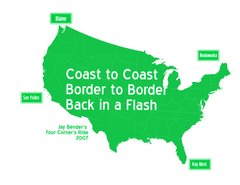
Madawaska was Ed's third corner and he was off to Key West to finish the quest. Ed had come east from Blaine, Washington through the U.S., and had encountered hail and thunderstorms as well as fog. We're both hoping for better weather headed down the coast.

But, back to hospitality. While Ed and I were chatting about our experiences on the road we were joined by Christina Therrien, the Madawaska town manager. Christina had a small stuffed bear outfitted in motorcycle riding gear for each of us as a welcome gift from the town.

Madawaska pays more attention to the Four Corners ride than do the other stops on the circuit. In fact, the town is planning a monument to the ride. To raise money for the monumbent the town is selling paving stones. Financial contributors will have stone of one color while financial contributors who have completed the ride will have pavers of a different color. I have a form to send back with my check.

Christina was joined by the town's police chief who stayed to chat briefly before going off on his morning rounds. I would have included his picture in the shots above, but I couldn't figure out how to clear enough memory in the camera to take the shot. (I have now learned how to delete photos after they have been stored on the memory card.) Several post office patrons asked if we were doing the Four Corners. They all said thanks for coming here.

The Executive Director of the Madawaska Chamber of Commerce, Barbara Deschaine, came by and invited Ed and me to stop in at the Chamber before leaving town. Barbara and her assistant Karen Lavoie are picture beneath a Chamber banner on a street lamp.

Barbara gave each of us a Certificate of Award to certify that we had been to Madawaska, "the most northeastern town of the Nation."

From the Chamber I walked to the Madawaska Public Library to take advantage of the wireless connection to file this report. The USC journalism and library schools were merged several years ago, and I think the common technological element making the merger feasible is the Internet. Librarians and journalists are in the information collection and dissemination business, and today that work is done by computer. All of my students at the USC Law School bring laptops to class. In theory they're taking notes, but I have some notion that on some days what is appearing on those screens has nothing to do with my lecture.

For the record it took 16 days to travel the 9,267 miles to get from Columbia around to Madawaska. I might have been able to do it faster, but it might have been riskier, and probably not as much fun.

I mentioned in an earlier blog that I might not be able to get back into the country. I didn't really have any belief that I couldn't get in, but I did have to park the bike and come into the station with my passport. I suppose the problem was that when I was asked by the agent at the crossing what my destination was for the night I replied, "As far as I can get before dark." Had I said Hyde Park, New York, I probably would have been waved through. Oh, well. I'm back in the country, and I think I should celebrate by going to McDonald's.

Appropriately enough the Four Corners monument model in Madawaska is standing beside the McDonald's. I say appropriately because I suspect that many folks on this ride eat a lot of fast food. The fellow rinning the gas station told me that the highest number of Four Corners riders passing through Madawaska was 300 in one year. He said, "Of course, not all of them finish it." I thought to myself, I did.

Now, it southbound and down. I'm heading for my son Todd's house in Hyde Park. If I get a chance, I'll try to call my friend Rob Gips as I go through Portland, Maine. Rob represents Indian tribes, and has provided sage counsel and advice to the Catawba Indian Nation.

I have some more photos to share, including a series on Indian finance in the high desert. And I have a picture of one of the moose warning signs I've been describing.

Monday, May 28, 2007

Almost to the border

My visit with David Wilkins followed by lunch kept me in Ottawa until noon. As I rode east toward Montreal and Quebec I was optimistic that I could get to Madawaska, Maine by dark. As has been the case with many of my efforts at predicting a schedule, I didn't make it.

Traffic through Montreal was at a near standstill, but aside from the delay the traverse was uneventful. I don't speak or read French, so it is an adventure to try to decipher the highway warning signs that are almost always exclusively in French. In Ontario the signs were bilingual.

The wind was as strong as it has been at any point of the trip and was roaring out of the north. I spent much of the day leaning left, but some of you may have noticed that I have a natural inclination in that direction.

The clouds were thick and gray, but because they were high, they didn't seem to be threatening rain. East of Quebec the gray clouds were being chased by some white fluffy clouds and blue sky. To the north shafts of sunlight made the St. Laurent Strait glisten while off to the south the sunlight alternated with the gloom to give the farming country a hackneyed landscape painting look. It is much more attractive in life than it is on canvas.

From the frequency with which I passed dairy farms, I would suspect that the eastern end of Quebec is the milk producer for the province. Even those farms I didn't see I could smell.

I mentioned in an earlier post that a warning sign for elk would slow me down. Dramatic and repeated warning signs for moose really apply the brakes. I didn't see any moose, but I didn't mind. My experience with moose during my Alaska trip lead me to believe that moose are large, surprisingly fast and not very bright. I have no interest in getting close to one while I'm riding.

At Riviere-su-Loup I turned south to head for the border. Guess what happened? It started to rain, the clouds got lower, and it got dark. On top of that, one of my driving lights has been working only when the mood strikes. The mood didn't strike after a late afternoon bathroom break even though it had worked all day.

Rolling south it got darker and the moose signs seemed to appear more frequently. I decided Madawaska could wait until morning. Besides, there needs to be light for the photos, right?

I bailed out, and found another classic road trip motel. I'm in Motel Claude in Deglis, Quebec. The room is clean, comfortable and connected. As a plus, there is a restaurant in a truck stop a short walk away. The desk clerk invited me to park my bike under the roof overhang outside my room. I took him up on the offer even though anything on the bike that can get wet is already wet.

Did I mention that I was close to the border? To my surprise, upon closer examination of my map, I learned that I won't be going from Quebec to Maine. There is a little swatch of New Brunswick between Quebec and Maine. I've never been to New Brunswick, so I'm looking forward to the opportunity. There isn't much English being spoken here in rural Quebec. I wonder how much French is being spoken in New Brunswick.

I think I can make a prediction on schedule. I will be in Madawaska Tuesday unless a moose gets me first.

A charming capital


Montreal, Quebec, Vancouver and Toronto probably come first to mind when one thinks of a visit to a Canadian city.

But, after roaming around the capital district Monday, I'd like to come back for a longer visit. The parliment building resembles the London original, and there is probably a great deal of North American history that we haven't been exposed to in the United States.

The market stalls in the Byway Market were colorful with fruits, vegetables, flowers and trinkets for sale. The tomato stand display features a replica of the Stanley Cup, the trophy given to the winner of the National Hockey League's playoffs. Ottawa is playing in its first finals in many years, and hasn't won the cup since before World War II. Hockey fever is high in Ottawa.

In addition to the capital area and the market, another attraction is an extended paved path along the Ottawa River, and it draws walkers, runner and skateboarders.

While I didn't spend much time in Ottawa, and my visit was limited geographically, I liked the scale of the place. It felt as if it had enough to see and do over a four or five day visit.

Best ambassador ever


A columnist in Monday's Ottawa newspaper ranked David Wilkins as the best U.S. ambassador to Canada ever.

One of David's characteristic that drew praise from the columnist was that he was a good listener, and he didn't act as if he had all of the answers to the problems facing the U.S. and Canada.

David has always managed to get along with people, even those with different political affiliations and outlooks than his. David was the first Republican House member to be elected chairman of a legislative committee since Reconstruction, and he did it when Democrats were in the majority. As Speaker David presided over the compromise that removed the confederate flag from the legislative chambers and from the dome of the Statehouse even though there were many members of his party who opposed the moves.

In addition to David's posting in Canada, South Carolina has had a number of ambassadors in recent years, John West to Saudi Arabia, Phil Lader to the the Court of St. James and Weston Adams to Malawi. The tenure of each has been characterized by an ability to be persuasive and effective without being overbearing.

When Phil Lader was ambassador to Great Britain he walked from one end of England to the other. David would have to serve several terms to be able to walk across Canada. This place is big.

David and I met outside the embassy Monday morning since it was a holiday and the embassy was closed. David invited me back for a tour of the place, and I'd like to take him up on the offer.

I had parked the bike a block or so away from the embassy so David and his Royal Canadian Mounted Police security staff walked down for a look. Since David is a politician and I'm a former lobbyist, we had our picture taken together.

While we were visiting at the bike one of David's sons, James came strolling down the street with his wife, Marnie Record. I persuaded them to pose with David and the bike. James works at Furman University in Greenville, S.C., and his focus is on making the campus more environmentally sustainable.

Our visit was short as David and his wife, Susan, had some errands to run, and in the afternoon they were taking some visiting relatives on a tour boat. On top of that, they were getting ready for a visit from the governor of California. Arnold's visit is creating quite a stir in the embassy and official Ottawa.

David and the security staff hopped in their official vehicle, a minivan, and I wandered off to look at the Byway market that has been a feature of the capital district since the 1800s. After a pub lunch of fish and chips, I headed out of town on the wind. Actually it was in a significant crosswind, but you get the idea.

Sunday, May 27, 2007

A slow go in northern Ontario

I don't have photographs from Sunday, but you can easily recreate the scenery. Go to your closet, get some gray flannel and hold it about an arm's length from your nose. After looking at that gray view for a few minutes, go stand in your shower with it and turn on the cold water. That was the day.

My twin left me a voicemail to let me know that there were typos in the blog. He figured it was because I was tired. He was right.

I had a hard time getting under way Sunday. When I awoke it was foggy and raining. I probably should have gone back to bed, but I stayed up and went to The Bobber for breakfast. Since I was in Canada I had Canadian bacon with breakfast It was good, but bore little resemblence to that which McDonald's puts on its Egg McMuffin.

I was entertained at breakfast by a Canadian woman in a group sitting several tables away from mine handicapping the Democratic presidential race. According to her Hillary Clinton has already won. I wonder what Gov. Bill Richardson of New Mexico thinks about that.

The discussion turned to the president's lack of approval rating, and someone in the group related that some American co-workers had expressed unhappiness with some action of the administration. The handicapper exclaimed, "Well, they shouldn't complain, they voted for him." I resisted the urge to explain that actually fewer than half of us voted for the Mr. Bush.

My route called for me to go to Sudbury, but my misreading of a highway sign gave me an opportunity to see the town twice as I circled around looking for a way out. From the parts of town I saw, Sudbury is not a thriving city, at least as reflected in its downtown (or city centre as the signs say). Sudbury is famous in professional hockey circles for being the home of some very tough and talented players.

As I got closer to Ottawa I saw increasing signs of Stanley Cup fever. There were signs on many of the buildings saying, "Go Sens." The local team, the Senators, is the first Canadian team to be playing in the the Stanley Cup finals in several years. The opponent is from that hockey hot spot Anaheim, California where the team is named after a Disney movie, The Mighty Ducks.

My rain suit absorbed so much water that I was worried that I might exceed the recommended gross vehicle weight. I started riding at 10:00 a.m., and rode until I reached Ottawa about 8:30. Except for an hour starting at 4:30 it rained the entire ride. The road was in rough shape for most of the way, and with the rain and fog I was considering calling it quits about 50 miles west of Ottawa. Just as I started looking for a cheap motel the rain diminished and the road improved, so I rolled on to Ottawa. I can't tell you anything about the capital of Canada yet because the rain picked up greatly as I rode into the city. I took the first motel I found.

By my calculation I am about 400 miles away from Madawaska, Maine and the fourth corner. I'm going to make an effort to catch up with Ambassador Wilkins in the morning and then head for Maine by way of Montreal and Quebec.